
A home by the Mediterranean, an investment you can be proud of, or a base for your family's future: Israel draws buyers from around the world. Buying from abroad can feel complicated, but with a clear plan and the right team it becomes a smooth, well-guided journey.
This guide gives you the essentials in a few minutes: the purchase tax at a glance, how financing works for buyers who are not Israeli citizens, and six steps from first idea to keys in hand.
Key Takeaways
Purchase tax at a glance: a buyer who is not an Israeli resident pays 8% on the price up to about NIS 6 million and 10% on the part above it, on our reading of the Tax Authority's rules.*¹ *²
This rate is temporary. The Tax Authority describes it as valid until 31 December 2026, so confirm the rate that applies on your signing date.*¹
Banks can help. Lending for a buyer who is not an Israeli citizen is capped at half of the property's value.*³
Your status matters. Israeli residents and new immigrants (olim) have lower rates.*² *⁴
Start with an Israeli lawyer and a clear plan.
Planning to buy in Israel? Tell Idith Dahan and the ID Real Estate team your budget, your status (foreign buyer, oleh or resident) and the areas you like, and get a clear first plan. Contact us
Important: tax rates and rules can change, and some of the rates in this guide are temporary. This guide is general information, not financial, investment, legal or tax advice. Before you commit to any purchase, take advice from a licensed Israeli lawyer and tax adviser who know your situation, and check the current figures with the Israel Tax Authority.
Purchase tax: the short version
Purchase tax is the biggest cost you can plan for, and the headline is simple.
Buyers who are not Israeli residents pay 8% on the price up to about NIS 6 million, and 10% on the part above that.*¹ *² There is no tax-free first band at this rate.*¹
Two things to know:
It is time-limited. The Tax Authority describes this scale as a temporary provision valid until 31 December 2026.*¹ After that date it may change.
Your status changes the rate. Israeli residents buying one home, and new immigrants buying a sole residence, pay lower rates.*² *⁴ Planning to make aliyah? The timing of your purchase matters, so read our guide to making aliyah.
Why "on our reading"? The Tax Authority's January 2026 circular does not name foreign buyers. Because the lower rates are reserved for Israeli residents, we read the 8% / 10% scale as the one for buyers who are not residents.*² That is exactly why you should confirm your own rate with a tax adviser and a lawyer before you rely on any figure.
Want to estimate your own tax? The Tax Authority offers an official online calculator.*⁵ Your lawyer will also help you file the declaration the Tax Authority requires within 30 days of the sale date.*⁶
Beyond the tax: what else to budget
A lawyer, an agent, land registry and bank fees come on top. They are negotiated rather than set by one official rate, so ask each professional for a written quote before you make an offer. Add everything up first, and you will make your offer with confidence.
Six steps from first idea to keys
Share your plan with us. Tell the ID Real Estate team your budget, your status and your goals. We help you shortlist the areas and properties that fit.
Appoint an Israeli real estate lawyer. Do it before you make an offer. The ID Real Estate team can recommend qualified lawyers. Ask the lawyer to explain the contract and agree the fees in writing.
Check the title and building rights. Ask your lawyer to check who owns the property, whether anything is registered against it, and what the municipality's records say about permits and building rights. The State offers a land registry (Tabu) extract as an online service.*⁷
Negotiate and sign. Have the lawyer review the contract before you sign. Ask which obligations and deadlines apply and what happens if you withdraw.
Declare and pay the purchase tax. The buyer files a declaration within 30 days of the sale date.*⁶ Ask your lawyer when payment is due.
Register ownership and collect your keys. Ask your lawyer to confirm the registration and to arrange the transfer of utilities and the municipal property tax (arnona) into your name.
Financing for buyers who are not Israeli citizens
Banks can lend, within limits. The Bank of Israel's directive on housing loans, as amended in April 2025 and clarified in December 2025, caps financing at half of the property's value when the buyer is not an Israeli citizen. Its official Q&A states that a home bought by a buyer who is not an Israeli citizen counts as an "investment dwelling", financed at 50% at most. *³ A mortgage broker can confirm your category, compare lenders and give you live quotes.
Buying from abroad
You do not have to be in Israel for every step. If you cannot attend the signing in person, ask your lawyer whether you can authorise them to act for you with a power of attorney. Ask what it covers, how it must be authenticated in your country, and whether it can be revoked. Your ID Real Estate agent can also help with the local procedures, so you can move your purchase forward without travelling to Israel in person. If you can, a visit before you sign is still worth it: no screen replaces standing in the street and the building.
Plan your banking and transfers early, and use a currency specialist for large transfers, because the exchange rate changes what the same home costs you.
Once you own: three things to plan
Arnona (municipal property tax). The municipality sets it. Ask your lawyer or the municipality what applies to your property.
Renting it out. The Tax Authority offers a reduced rate on residential rental income for people who are not required to file an annual return.*⁸ Have an Israeli accountant confirm whether you qualify. Our guides on earning rental income in Israel and the costs of renting out a property will help.
Selling later. Ask a cross-border tax adviser how capital gains tax would apply to you, and whether your home country also taxes the gain.
A market worth following
Recent official readings from the Central Bureau of Statistics show small monthly price moves.*⁹
Official city figures show how different the markets are. In the first half of 2026 (January to June, the latest quarter is provisional), the average price of a dwelling was about NIS 4.5 million in Tel Aviv-Yafo, about NIS 3.1 million in Jerusalem and about NIS 3.8 million in Herzliya.*¹⁰ Compared with the same months of 2025, that is roughly +7% in Tel Aviv-Yafo, unchanged in Jerusalem and −1% in Herzliya.*¹⁰
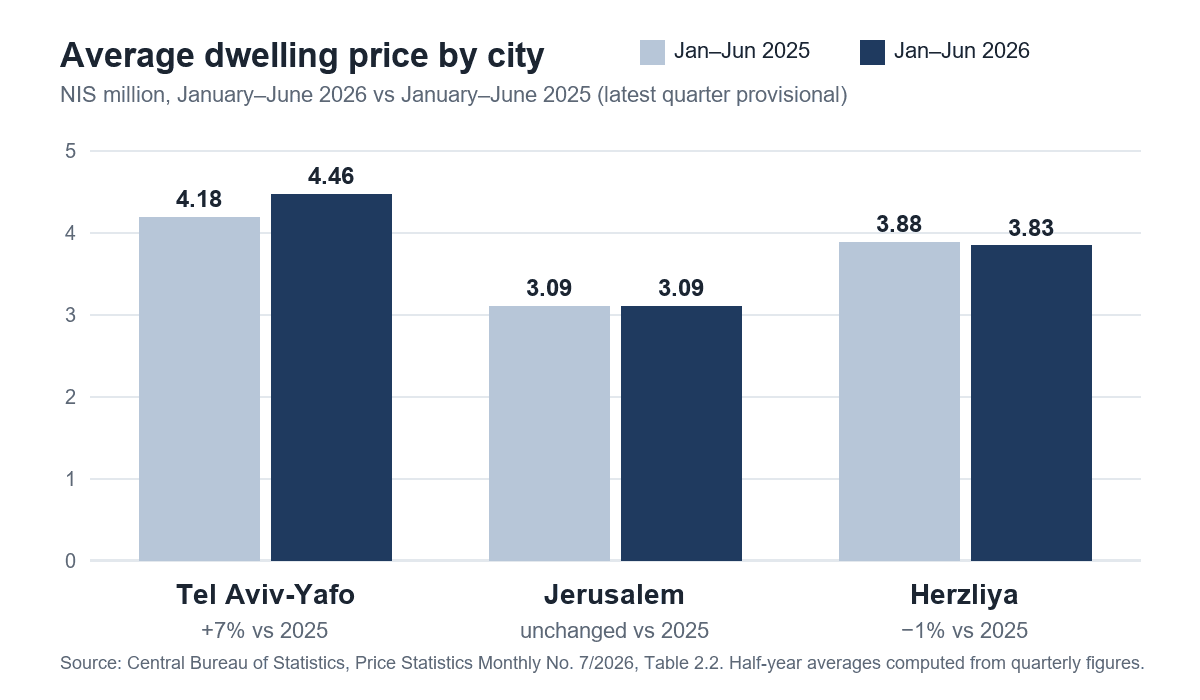
Averages mix different property sizes and neighbourhoods, and Herzliya's figures rest on far fewer transactions, so treat them as an illustration, not a forecast. Do not buy on a forecast. Plan around what you can control: your budget, your status, the legal checks, and how long you can hold the property.
Where to start looking
The right city depends on your budget, your commute, the community and schools you want, and whether you will live there or rent it out. Start with our guides to why Ra'anana attracts olim and why Netanya is an attractive investment.
Three mistakes to avoid
Signing before your lawyer has reviewed the contract.
Assuming a tax rate without checking the date. The current 8% / 10% scale is described as valid until 31 December 2026.*¹
Relying on unofficial numbers. Check the Tax Authority's calculator,*⁵ and ask your lawyer for the figures that apply on your signing date.
Frequently asked questions
How much tax do foreigners pay when buying property in Israel?
On our reading, a buyer who is not an Israeli resident pays 8% up to about NIS 6 million and 10% above, valid until 31 December 2026.*¹ *² Rates can change, so confirm yours with a tax adviser.
Do I need a lawyer to buy property in Israel?
We recommend one. An Israeli lawyer can explain the contract before you sign, check the land registry and building rights, and help you with the tax declaration. Agree the fees in writing.
Is it safe to buy property in Israel right now?
No guide can answer that for you. Recent official price readings show small monthly moves,*⁹ and you should weigh the security situation in your own risk assessment. Base the decision on your time horizon, the legal checks and a budget that tolerates a slow market.
Next steps
Confirm your status and budget. Appoint an Israeli lawyer and a mortgage broker. Then view properties that fit your plan with a team that knows the local market.
Ready to talk about your purchase? ID Real Estate is a Herzliya-based agency that helps buyers find, evaluate and complete purchases in Israel. Contact Idith and the team to discuss your plans, or read more about the agency.
About the author
Idith Dahan is a licensed real estate agent (license no. 3156684) and founded ID Real Estate in 2015. She was born and raised in Israel, lived for more than 20 years in Europe, and now works with buyers from her office in Herzliya (about the founder).
Disclaimer
This article is general information only. It is not financial, investment, legal or tax advice, and it does not create a professional relationship. Tax rates, thresholds and rules change, and some of the rates quoted here are temporary. ID Real Estate does not guarantee that the information is complete, correct or current. Before you make any decision or sign any document, take advice from a licensed Israeli lawyer, tax adviser and mortgage broker who know your situation, and check the current rules with the Israel Tax Authority. Each reader is responsible for verifying this information to avoid legal and financial problems.
Notes and sources
Each asterisk and number in the text matches a note below. Figures were checked on 18 October 2026. All sources are official Israeli government sources. The exact figures behind the rounded numbers in the text are given here.
*¹ Israel Tax Authority, Land Taxation Implementation Circular No. 1/2026 of 18 January 2026 (in Hebrew), section 2.B: 8% up to NIS 6,055,070 and 10% above for a residential apartment that is not a sole apartment, a temporary provision valid until 31 December 2026. The circular does not name foreign buyers; the application to non-residents follows from note 2. gov.il circular (PDF)
*² Same circular, section 2.A: the lower sole-apartment scale applies to an "individual who is an Israeli resident", from 16 January 2025 to 15 January 2028.
*³ Bank of Israel, Banking Supervision Department, Proper Conduct of Banking Business Directive 329, "Limitations on Issuing Housing Loans", current version [11] of April 2025 (in Hebrew): loan-to-value caps of 75% for a sole dwelling, 70% for a replacement dwelling and 50% for an investment dwelling; the first two apply only to an Israeli citizen, and "non-resident" means anyone who is not an Israeli citizen. Circular of 16 December 2025 (in Hebrew) amends the directive on other points (payment-to-income calculation, value cap for reduced-price homes) and updates the official Q&A, whose question 2.4 states that a purchase by a non-resident is necessarily an investment dwelling with a maximum financing of 50%. We found no later amendment that changes this for non-residents, but confirm the current text with a broker. Directive 329, April 2025 (PDF), Circular of 16 December 2025 and Q&A (PDF)
*⁴ Same circular as note 1, section 2.C: reduced scale for a new immigrant (oleh) buying a sole residence, for a purchase between one year before and seven years after aliyah, from 16 January 2025 to 15 January 2028.
*⁵ Israel Tax Authority, purchase tax calculator. Run on 18 October 2026 for a "residential apartment" with standard calculation, it returns 8% on a NIS 4,000,000 purchase (NIS 320,000), consistent with note 1. Calculator page on gov.il (the "Calculate" button opens the calculator, which is in Hebrew).
*⁶ Israel Tax Authority, declaration form on the sale and purchase of real estate (form 7000): the buyer files a declaration within 30 days of the sale date (section 73(c) of the Real Estate Taxation Law). gov.il service page
*⁷ Israel Government, Land Registry: online service to order a Tabu (land registry) extract. gov.il service page
*⁸ Israel Tax Authority, application to open a file for tax on residential rental income at a reduced 10% rate (form 3302). The page does not address non-residents. gov.il service page
*⁹ Central Bureau of Statistics, "Price Changes in the Dwellings Market": September 2026 release (15 October 2026, publication 325/2026, -0.6% for July and August against June and July) and August 2026 release (15 September 2026, publication 292/2026, +0.2%). Two-month comparisons, not annual changes. Data not final.
*¹⁰ Central Bureau of Statistics, Price Statistics Monthly No. 7/2026 (published 15 October 2026), Table 2.2, "Average prices of dwellings by district and big city" (all dwellings, NIS thousands, not quality-adjusted). Half-year averages are our own computation from the quarterly figures, weighted by the number of transactions: Tel Aviv-Yafo 4,178.9 (Jan–Jun 2025, 1,604 transactions) and 4,462.1 (Jan–Jun 2026, 1,935); Jerusalem 3,093.3 (2,026) and 3,093.7 (1,820); Herzliya 3,877.5 (544) and 3,830.3 (300). The latest quarter (Q2 2026) is provisional and based on fewer reported transactions. CBS table 2.2 (PDF)
MORE POSTS